A number in an erectile dysfunction study needs more than a treatment name beside it. It needs a unit. Questionnaire points, percentages of recorded encounters and percentages of participants are not interchangeable, even when they appear in the same results paragraph. A larger number on one scale cannot simply outrank a smaller number on another. The first task is to identify what changed, how that change was calculated and which comparison supports the conclusion.
This reading of the daily tadalafil research follows those units through the report. Its historical 10 mg daily arm is not the current routine daily ED regimen: current Cialis labeling describes 2.5 mg, with an increase to 5 mg when appropriate. Those label details provide context, not personal dosing instructions. The scientific question here concerns interpretation of measured outcomes. All worked examples below are invented to explain arithmetic; they are not reconstructed participant data.
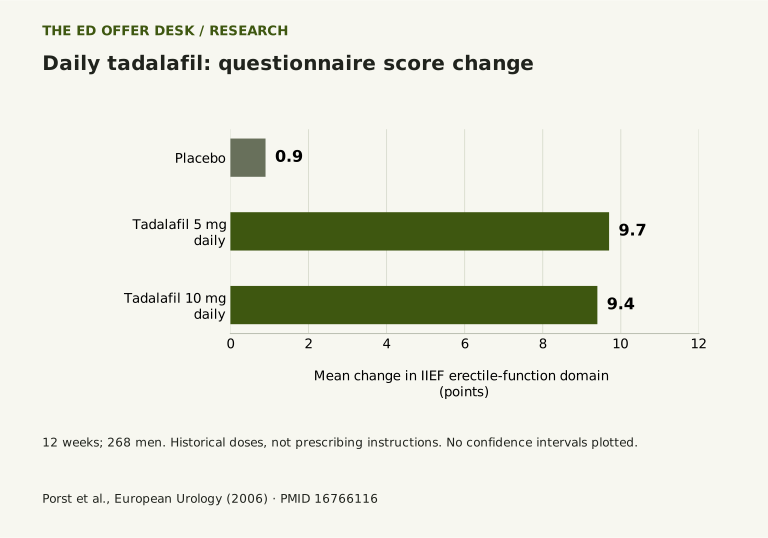
Trial chart and data
Download chart (PNG) · Download data (CSV) · Download vector (SVG)
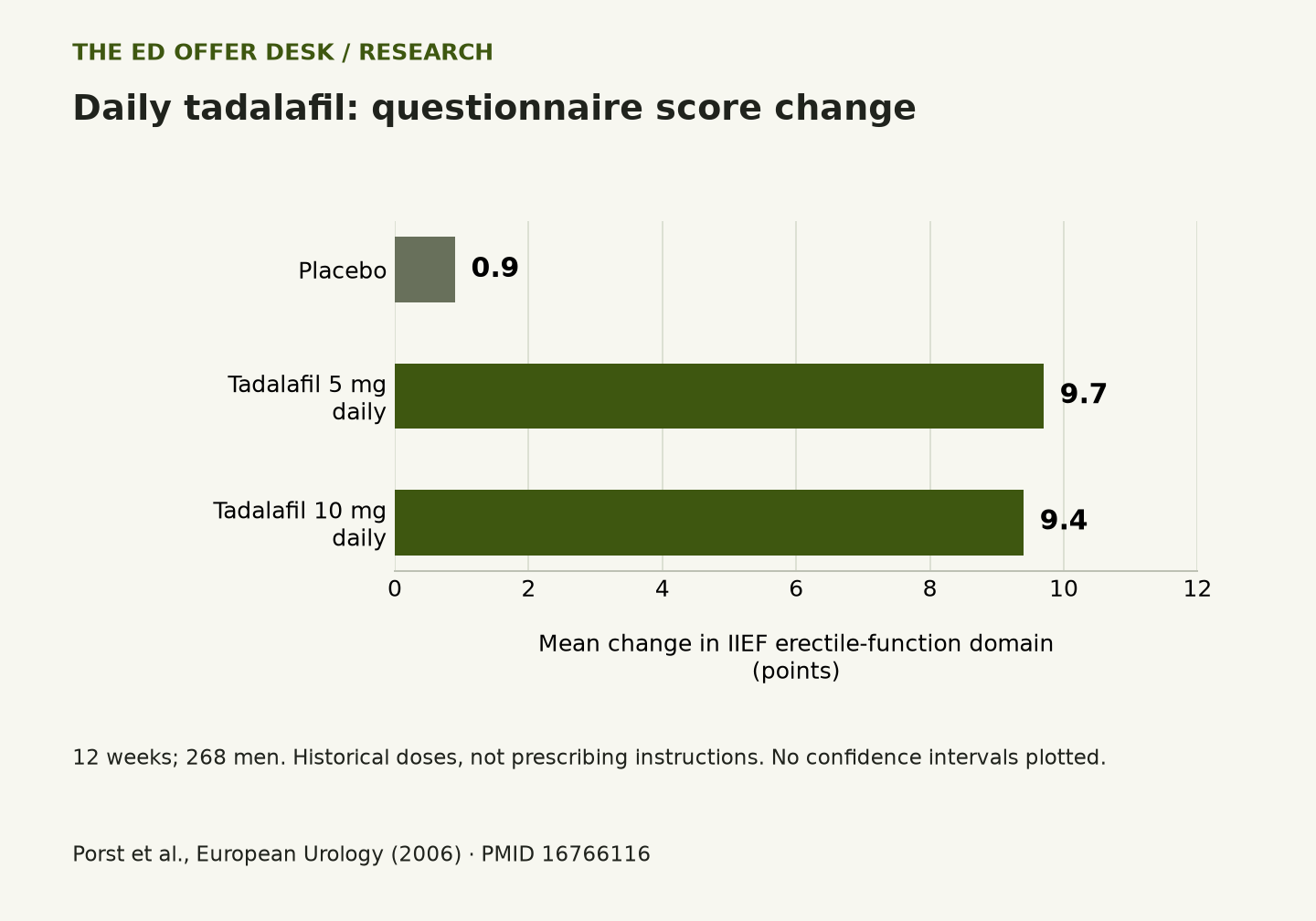
| Historical study arm | Reported value |
|---|---|
| Placebo | 0.9 |
| Tadalafil 5 mg daily | 9.7 |
| Tadalafil 10 mg daily | 9.4 |
12 weeks; 268 men.
Historical doses, not prescribing instructions. No confidence intervals plotted.
Locate the experiment before reading the chart
The double-blind trial used 1:2:2 randomization; nine participants (3.4%) withdrew for adverse events.
The chart isolates one question from that larger experiment. IIEF-EF means the erectile-function domain of the International Index of Erectile Function questionnaire. Its unit is a point on that defined scale. Before comparing the bars, read whether the plotted quantity is a change or an ending level. A change describes the movement from a starting measurement; it does not show where a group ended unless the starting measurement is also known.
Keeping one outcome in one chart makes the display easier to read, but it does not make other outcomes irrelevant. A useful appraisal asks how the questionnaire result relates to experience recorded in diaries, to participants’ broader judgments and to tolerability. The challenge is to keep each answer in its own unit while considering the overall pattern. Combining all outcomes into an informal score would hide the choices about how much weight each receives.
Write the starting value beside the change
Consider two fictional groups on an invented questionnaire. One starts at 12 points and gains six; another starts at 20 and gains four. The first improves more in points, while the second ends higher. Both statements are arithmetically correct. Neither says which treatment caused a better result because the example contains no randomized comparison or information about the scale’s clinical meaning. It simply shows why a change and an ending level answer different questions.
For a real comparison, the analysis must address the study design and starting measurements, rather than invite readers to select whichever summary looks most favorable. A raw change can be informative, but a complete report should make its calculation and comparison clear. If a report only supplies a change estimate, the absent starting and ending values should remain absent; do not infer them from the size of the bar.
This distinction also explains why the questionnaire chart cannot be compared numerically with an event-percentage chart. The sildenafil denominator analysis follows a different measurement unit. Converting both figures to equally tall bars would make their appearance similar without making the underlying quantities comparable.
| Quantity | What it answers | Information still needed |
|---|---|---|
| Starting score | Where the measurement began | The scale and participant distribution |
| Ending score | Where the measurement finished | Starting value and follow-up definition |
| Change in points | How far the score moved | Comparator and uncertainty |
| Change in percentage points | How far a percentage moved | Starting percentage and event definition |
| Threshold classification | Who met a stated rule | The rule and the analyzed population |
A group mean leaves the distribution unresolved
A mean is the sum of values divided by their number. That arithmetic can conceal very different patterns. In an invented three-person example, changes of minus two, four and ten have the same mean as changes of four, four and four. The average is identical, but the individual experiences are not. Neither example describes the trial; they show why an average alone cannot reveal how consistently people improved.
The distribution matters when the question changes from whether a group improved on average to what range of responses occurred. Useful additional evidence might include the spread of changes, the proportion meeting a prespecified response criterion and an analysis of incomplete measurements. These summaries would answer distinct questions. They should be requested from the underlying research rather than fabricated from a mean.
The two active-arm means in a chart also require disciplined interpretation. Numerical closeness does not prove equivalence, which requires a suitable design, margin and uncertainty analysis. A slightly higher mean does not establish superiority either. A reader can accurately describe the displayed ordering while declining to turn it into a preference between doses. That is a limit of the evidence shown, not a claim that the treatments must be identical.
Translate diary changes without changing their units
SEP2 concerned penetration; SEP3 concerned successful intercourse completion. SEP stands for Sexual Encounter Profile, a diary measure. The methodological point is that a change in the percentage of positive responses is a movement between percentages. It is not itself the final percentage, and it is not a count of participants who experienced an improvement.
For a fictional diary example, a positive-response percentage rising from 30% to 55% has increased by 25 percentage points. Relative to its starting percentage, the increase is about 83%. These two descriptions use the same observations but different denominators. Calling the change a 25% relative increase would answer a different calculation. Calling it a 25% ending success rate would discard the starting value altogether.
Diary summaries also need their observation rules: which encounters were eligible, how records were completed and how missing entries were treated. An unrecorded encounter is not automatically a recorded failure or success. As an editorial implication, the diary unit should not be converted into an expected medication quantity. The supply and refill guide examines that separate commercial question without predicting a reader’s pattern of use.
Distinguish improvement from crossing a threshold
A participant’s judgment that things improved and a questionnaire classification address different questions. The first asks for a reported change in experience. The second applies a defined rule to a measurement. A person might report a meaningful improvement without crossing a threshold, or cross a threshold after a small numerical change. Those possibilities are methodological explanations, not descriptions of particular trial participants.
Imagine an invented scale from zero to twenty, with a classification rule at ten. A change from two to nine is seven points but does not cross the rule. A change from nine to ten is one point and does cross it. The rule gives a reproducible way to classify results, yet the classification leaves out the size of the change. A threshold also does not automatically describe every aspect of sexual health or a permanent cure.
When several outcome types are reported, ask whether their definitions were chosen before the analysis and whether the interpretation keeps their differences visible. A broad improvement statement should not quietly become a claim that all symptoms resolved. Equally, failing to meet a classification rule does not prove that no change occurred. Keeping the underlying score and the classification separate allows a more complete account than selecting only the more impressive-looking percentage.
Read allocation and uncertainty as different design questions
An unequal randomization ratio changes the intended distribution of participants across study groups. It does not authorize a reader to calculate exact analyzed group sizes by dividing the total and rounding. Assignment, follow-up and inclusion in a particular analysis are separate stages. Such an allocation ratio describes a design choice, not the number of participants included in a particular analysis.
The placebo comparison is also distinct from a comparison between active regimens. An experiment may be designed to test each active group against placebo without establishing equivalence or superiority between the active groups. To assess a particular contrast, a reader needs the corresponding estimate and uncertainty, along with the analysis plan. A significant result for one contrast cannot be transferred to a different contrast by inspection.
We have not added confidence intervals to the chart. Without the underlying variability and analytic details, a plausible-looking interval would still be invented. Statistical precision, clinical importance and an individual’s likely experience remain separate questions. A clear report identifies which of those questions its calculations can address and which require additional evidence.
Keep tolerability separate from a safety decision
An adverse-event withdrawal count describes one way that an unwanted experience can affect participation. It is not the count of everyone who experienced an adverse event, and an overall count does not identify a separate rate for each arm. The interpretation needs the event definition, severity, timing and exposure period. Those details cannot be supplied by substituting rates from another trial or a pooled label table.
Current Cialis labeling contraindicates nitrates and guanylate cyclase stimulators such as riociguat. Continuous exposure with daily use matters for interactions; alpha blockers, antihypertensives, strong CYP3A4 inhibitors and substantial alcohol require review. Cardiovascular suitability and kidney or liver impairment matter. An erection lasting more than four hours needs immediate help. Sudden vision loss or hearing decrease or loss calls for stopping treatment and prompt medical attention. The label advises against taking other PDE5 inhibitors.
A personal safety assessment therefore needs a clinical review of the actual medication list and health circumstances. This article cannot supply that review. For the service side, the support-promise guide offers questions about access and responsibility. Clear written support terms can help clarify a process; they do not demonstrate that a study’s tolerability findings apply to a particular person.
Use disclosures without assuming a direction of bias
Indexed Acknowledgments identify Lilly ICOS LLC funding and Lilly Research Laboratories writing/editorial support. Full author conflict declarations were not independently accessible. We reviewed the indexed abstract and primary disclosure excerpts, alongside relevant sections of official labeling and FDA material. We did not obtain the complete research paper, protocol or patient-level dataset.
Funding and assistance belong in an appraisal because they describe relationships relevant to how research was produced. Those relationships do not calculate the size of any bias. A useful appraisal would compare the protocol, planned endpoints, complete results and interpretation rather than declare a finding valid or invalid from the sponsor’s identity alone. The unanswered questions should be stated specifically enough that another reader could investigate them.
Product identity creates a separate evidence boundary. FDA does not approve compounded drugs or review their safety, effectiveness and quality before marketing. That statement does not quantify the risk of a particular preparation or make every instance of compounding unlawful. Our editorial interpretation is to examine formulation and route before linking an offer to a trial. The full-formula guide organizes those documentary questions without treating a shared ingredient as proof of equivalent performance.
Compare scientific questions before comparing services
A historical tadalafil trial and a historical sildenafil report do not form a head-to-head experiment. Differences in intervention, observation period, measurements and participants would need to be addressed before drawing a comparative treatment conclusion. It is not enough for both reports to concern erectile dysfunction. A common condition does not make every endpoint or regimen exchangeable.
One useful editorial exercise is to write the proposed comparison as a complete sentence before collecting numbers. Does it compare average questionnaire change, event-level success, a patient-reported response, or a service term? Then identify the evidence required for that exact sentence. If the available sources answer a different question, revise the question or leave the conclusion open. Do not silently switch units to make the evidence fit.
The Ro Daily Tadalafil review and Hims Tadalafil review are links for examining documentary descriptions and terms on this site. They do not imply that either service reproduces the study or has measured outcomes matching it. Current Viagra labeling separately advises against combinations with other PDE5 inhibitors or ED therapies; cross-study reading is not an invitation to combine treatments.
Build a comparison record that preserves unanswered questions
A practical record can hold clinical and commercial information without merging their units. Put the outcome definition and study reference in one place, the exact product identity in another, and the order terms in another. This allows each statement to carry its own evidence. It also makes it possible to revise a price term later without pretending that a clinical conclusion changed at the same time.
The table below is an editorial checklist, not a scoring system. An unanswered question stays unanswered. A documented service fee does not establish a treatment response, just as a clinical result does not establish the amount a customer will ultimately pay. The starting-price guide addresses the order-total question using its appropriate records.
This method also makes follow-up more concrete. Instead of asking whether an offer is scientifically good, ask which exact product, outcome, observation window or contractual term needs clarification. A specific question can receive a specific answer. The purpose of reading the trial carefully is to improve the quality of that question, while leaving individualized treatment decisions to a clinician who can assess the person concerned.
| Question to resolve | Evidence to seek | Avoid substituting |
|---|---|---|
| Is the product comparable? | Ingredient, formulation, route and regimen details | A shared ingredient name alone |
| What benefit was measured? | Endpoint definition and observation period | A general satisfaction claim |
| How uncertain is the estimate? | Relevant comparison and interval analysis | The apparent height of a bar |
| How is suitability assessed? | Clinical screening and medication review | A historical group average |
| What will the order involve? | Written total, supply and renewal terms | A trial-based cost-per-benefit forecast |
Questions about the evidence
Can I recover an ending score from the change shown in the chart?
Only if the corresponding starting score is known and the summaries use compatible definitions. A change by itself leaves the ending level undetermined. Do not borrow a starting value from a different study or population to fill that gap; doing so creates a new estimate with unsupported assumptions.
Why not express every outcome as a percentage?
A percentage needs a meaningful denominator. Dividing questionnaire points by an arbitrary number can produce a percentage mathematically without producing a clinically interpretable measure. Keep the instrument’s unit unless a validated transformation is specified. Comparable-looking percentages can otherwise conceal fundamentally different questions.
Does an unchanged group average mean that nobody improved?
No. Positive and negative individual changes can cancel in an average. Conversely, a favorable average does not establish improvement for every participant. The distribution and a clearly defined response analysis provide information that the average alone leaves unresolved. These are general properties of summaries, not additional trial findings.
What would establish that two regimens perform similarly?
The claim needs an appropriate comparison, a prespecified meaning of sufficiently similar, and uncertainty narrow enough to support that meaning. Visual closeness of two estimates cannot supply those elements. Nor does a failure to demonstrate a difference automatically establish equivalence between the regimens.
Which information should come from the current label rather than the historical paper?
Present-day prescribing context, contraindications, interactions and urgent safety instructions should be checked against current official labeling and reviewed with a clinician. The historical paper remains useful for its specific research question. Keeping those sources in their appropriate roles prevents an old experimental regimen from becoming informal personal advice.
Editorial assessment
The clearest reading of this daily tadalafil study preserves the distinction between a score, a change in that score, a diary percentage and a participant-level classification. Each summary can contribute evidence, but none is a universal success rate. The chart offers one view of the experiment; the worked examples show how to interpret its unit without inventing individual responses. For readers comparing services, the next step is to keep product identity, clinical screening and written order terms alongside the science as separate records. That approach produces questions the evidence can answer and leaves unresolved questions visible.
Research access and limitations
This analysis uses indexed primary abstracts, indexed primary funding disclosures and currently served official labels and FDA material. The complete trial articles, protocols, full conflict declarations and individual records were not reviewed. Charted values have no invented uncertainty intervals. Worked numerical examples are fictional explanations. No treatment ranking, personal dosing recommendation or claim of equivalent performance for a provider or compounded product follows from this article.
Check the source
Scientific source checks are dated individually below. Original provider checks remain dated October 6 or 7, 2026. Provider material establishes advertised terms, not independently verified clinical results.
- Porst et al. (2006): daily tadalafil trialAbstract and indexed funding excerpts · Checked 2026-10-23Indexed funding disclosure
- Cialis (tadalafil) prescribing informationOfficial prescribing information; relevant sections reviewed · Checked 2026-10-23
- Goldstein et al. (1998): oral sildenafil trialAbstract and indexed funding excerpts · Checked 2026-10-23Indexed funding disclosure
- Understanding the risks of compounded drugsFDA public guidance · Checked 2026-10-23
- VIAGRA (sildenafil citrate) US prescribing informationOfficial prescribing information; relevant sections reviewed · Checked 2026-10-23