A percentage becomes useful only after its denominator is clear. In erectile dysfunction research, the thing being counted might be a man, an intercourse attempt, a questionnaire response or a return visit. Those units answer different questions. An attempt-based result describes recorded events; it does not, by itself, tell us how many people experienced a dependable benefit. Reading the original sildenafil research through those distinctions gives a more precise account than treating every favorable number as a general success rate.
The ED Offer Desk uses that distinction to examine the evidence behind a treatment category before examining the terms of a service. This article separates reported findings from original examples that explain their interpretation. The examples are invented arithmetic, not additional clinical observations. The aim is to make the route from observation to conclusion visible: identify the comparison, keep its unit attached, ask what information is missing, and then decide which question the result actually answers.
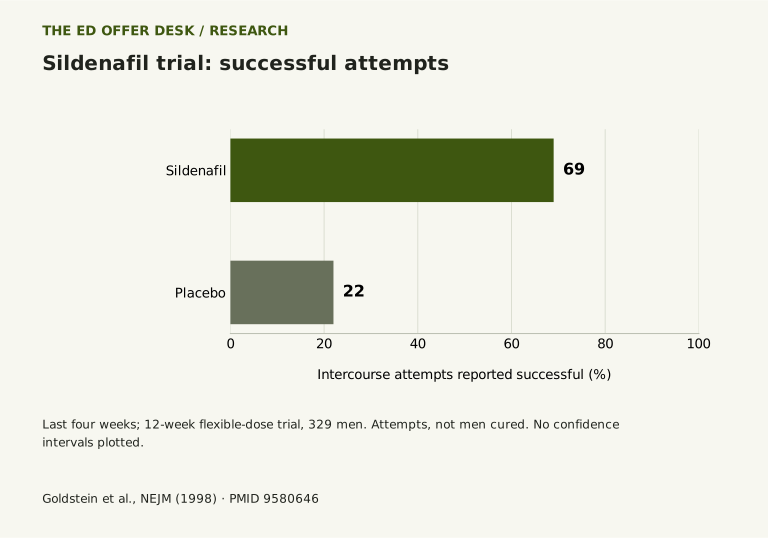
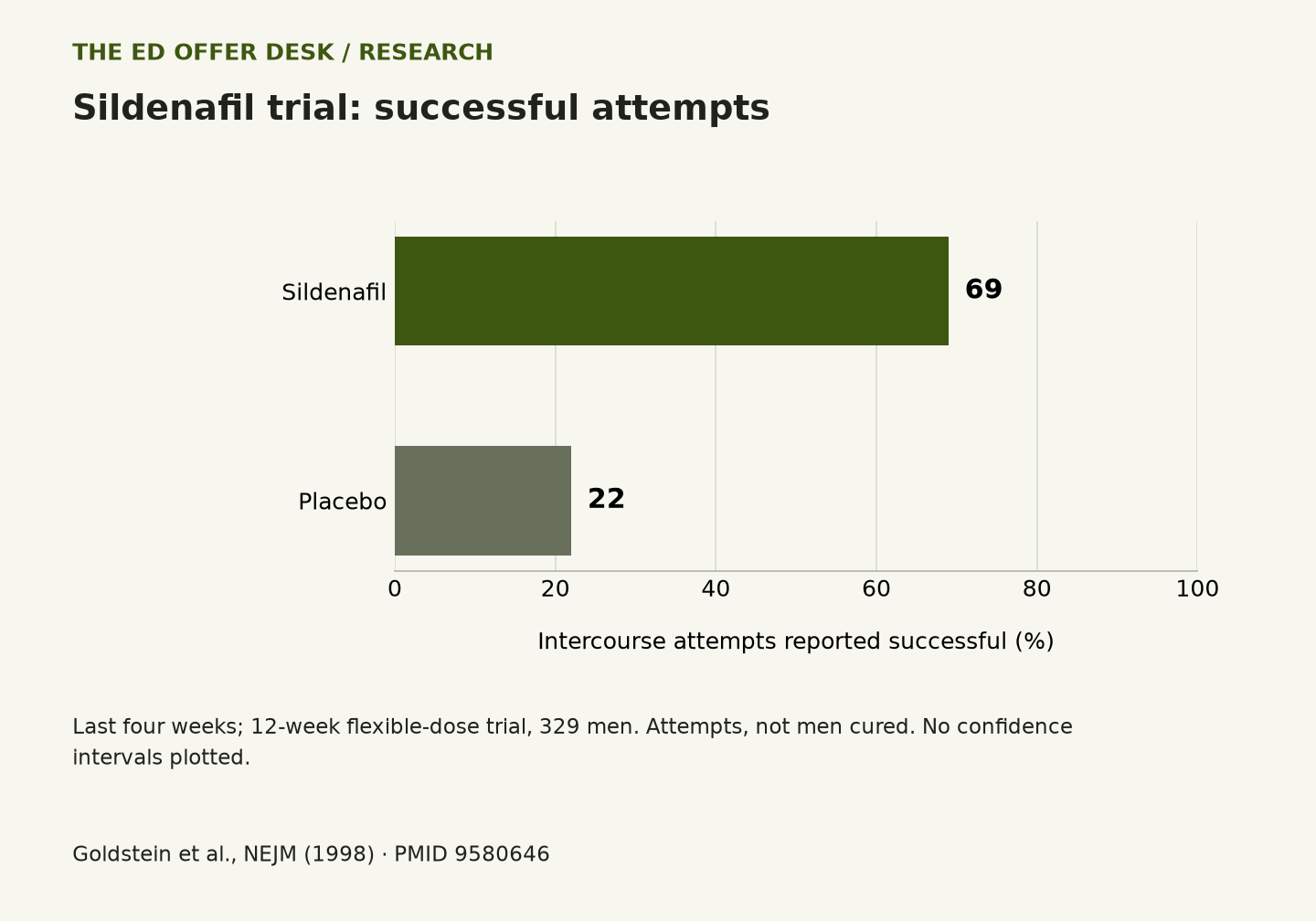
Trial chart and data
Download chart (PNG) · Download data (CSV) · Download vector (SVG)
| Study group | Reported value |
|---|---|
| Sildenafil | 69 |
| Placebo | 22 |
Last four weeks; 12-week flexible-dose trial, 329 men.
Attempts, not men cured. No confidence intervals plotted.
Keep the two studies on separate lines
Two oral, as-needed experiments studied 532 men for 24 weeks and 329 for 12 weeks. In the 12-week flexible-dose study, successful attempts/month were 5.9 (sildenafil) versus 1.5 (placebo); headache, flushing and dyspepsia occurred at 6–18%, without symptom-specific rates in the abstract. Of 225 entering a 32-week open-label extension, 92% completed.
The correct reading is to keep each observation attached to its own experiment. Adding enrollment counts may describe the scale of a research program, but it does not create a single trial with one shared follow-up period. Nor does it allow every reported outcome to inherit the combined sample size. A useful reading sheet has a separate line for each experiment, with its participants, comparison, observation period and measurement.
That same discipline applies when comparing this report with the daily tadalafil measurement analysis. Start with the scientific question and the outcome definition before looking for a larger number. A difference between two reports can arise from how a question was asked as well as from the treatment being studied.
Repeated attempts are not independent people
Consider an invented example with two participants. One records one success in one attempt; the other records one success in nine attempts. Pooling events gives two successes in ten attempts. Averaging the two personal success fractions gives a different result: the first contributes 100% and the second about 11%, with equal weight given to each person. Neither calculation is automatically the correct study analysis. They simply target different summaries, and the reporting method must say which one was used.
Repeated observations also share a participant. Ten attempts from one person are not equivalent to ten people each contributing one attempt. Experiences from the same person may be related, so a calculation of uncertainty needs to account for that structure. The relevant question is how the analysis handled repeated observations, not whether a large event count looks impressive. The accessible abstract does not supply enough detail to reconstruct that calculation.
Use the worksheet below when a claim arrives without its denominator. It identifies missing information without guessing a missing result. The same approach is useful while reading how to compare ED treatment offers: a clinical statistic should retain its original unit when it appears beside a commercial description.
| Claim format | Quantity to identify | Question to resolve |
|---|---|---|
| A percentage of events | Successful events divided by eligible events | Were events pooled or summarized within each person? |
| A percentage of participants | People meeting a defined criterion | What counted as meeting that criterion? |
| A questionnaire result | A named scale or item | Is the result an ending score or a change? |
| A follow-up percentage | People who completed an observation period | Who was eligible to enter that period? |
A score change is not a probability
A questionnaire converts answers into a defined scale. Reading that scale requires three separate pieces of information: what the question measures, which values it permits, and whether the published number describes a starting value, an ending value or a change. Dividing a score by the largest possible score does not automatically turn it into a probability. The questionnaire was not necessarily designed to predict the chance of a future event.
Here is a fictional scale example, unrelated to any participant in the trial. A score moving from two to three has increased by one point. Relative to the starting score, that is a 50% increase. If the scale ends at five, the ending score occupies three-fifths of that numerical range. These are three descriptions of the same arithmetic, but none establishes a 50% or 60% chance of success. The interpretation comes from the measurement rules.
There is a further distinction between a group average and an individual trajectory. A mean improvement could arise from similar changes across participants or from a mixture of large changes and little change. Without a distribution, those patterns remain unresolved. A careful reader can recognize an improvement in the reported average while leaving individual predictability open.
Ask what the placebo comparison isolates
The value of a concurrent placebo group is the comparison it makes possible. A before-and-after change in one group does not, by itself, distinguish a treatment effect from changes that might also have occurred without that treatment. Comparing groups observed over the same period addresses a different question. Random allocation is intended to distribute other influences without selecting treatment according to expected outcome; blinding is intended to limit the influence of knowing the assignment.
These design features are reasons to examine an experiment seriously, not reasons to stop examining it. Execution still matters. A reader would want to know how assignment was generated and concealed, how outcomes were collected, whether participants learned their assignment, and how incomplete records were analyzed. We have not inspected the full protocol or complete paper, so those questions stay open rather than becoming assumptions about flawless methods.
A placebo-controlled result also differs from an active-drug comparison. Two medications can each have favorable placebo comparisons without their separate trials deciding which medication performs better. A direct comparison would need an explicit shared design and suitable outcome. The tadalafil article examines a different measurement problem; placing its chart beside this one does not create that missing experiment.
Keep the observation window attached to the rate
A rate is incomplete when the time window disappears. A monthly event count, an event fraction during a selected period and a questionnaire completed at a visit describe different views of experience. Even when all three point in a favorable direction, they should not be collapsed into one number. The time unit is part of the measurement rather than a decorative detail to remove from a short headline.
For an invented example, imagine four successful events among ten attempts in one month and three successful events among four attempts in another. The first month has the larger number of successes; the second has the larger fraction of successful attempts. There is no mathematical contradiction. The number of opportunities differs. Neither measure alone explains why opportunities differed or which month a person would consider more satisfactory.
This matters when interpreting a product quantity or subscription interval. Our editorial conclusion is that a trial event count should not become a forecast of how many doses someone will use or what their personal cost per successful event will be. The quantity and refill guide addresses the contractual quantity. Clinical outcomes and shipment quantities require separate evidence before anyone connects them.
Follow the participants into the extension
An extension asks a new question once participation moves beyond the original comparison. If people elect or qualify to continue, the later group is a selected set. That does not make the observations worthless. It changes the population to which the observations directly apply and makes the entry rules important. An open-label period also changes what participants and investigators know about treatment.
Consider a hypothetical follow-up exercise, not the sildenafil data. Of 100 people initially observed, 70 return for an optional visit and 63 of those report improvement. The fraction among returners answers a different question from the fraction among the original 100. Neither calculation reveals the unobserved experiences of the remaining people. Assigning them all success or all failure would be an assumption, not a recovered measurement.
Missing records deserve specific questions: how many were absent, why they were absent, and what analytic assumptions addressed them. Completion itself is a retention measure. It can help a reader understand how much follow-up was obtained, but it does not replace an efficacy outcome or an adverse-event table. A stronger interpretation keeps the entry population, observed population and outcome definition visible at the same time.
Separate a large difference from a precise estimate
An estimate describes the observed contrast. Its uncertainty describes how precisely the study can locate the underlying effect under its analytic assumptions. These are different properties. A large-looking contrast may still have an important range of uncertainty; a precisely estimated contrast may be small. A chart with two bars cannot supply the missing interval simply through visual neatness.
The indexed abstract does not provide confidence intervals or attempt counts needed to reconstruct uncertainty for the displayed outcome. We therefore show the reported values without invented error bars. A reported statistical significance statement would not solve this missing-information problem. A probability calculated under a null hypothesis is not a probability that an individual reader will benefit, and it does not specify the range of clinically plausible effects.
For the same reason, do not take the reciprocal of an attempt-level difference and call it a number of patients needed to treat. A patient-level treatment number requires a suitable patient-level outcome and a defined time horizon. Changing the denominator changes the question. Recognizing that boundary is more useful than producing an attractive extra statistic from information that cannot support it.
Read funding alongside the access boundary
Indexed journal Notes document Pfizer funding, author consulting relationships and sponsor assistance with design, logistics and analysis. Those are relevant relationships, but they do not specify the size or direction of any bias. Their purpose here is transparency. Treating sponsorship as automatic proof of invalidity would be as unjustified as treating a published finding as immune to scrutiny.
This analysis uses the indexed primary report abstract, indexed disclosure material and current official drug information. Complete journal text, protocols and supplements were not available for this review. That access boundary restricts the questions we can resolve, especially questions about detailed methods and complete event reporting. It should travel with the conclusion rather than disappear after the reference list.
A productive next step for a deeper appraisal would be to compare the complete protocol, analysis plan and paper: were the endpoints prespecified, how were incomplete observations handled, and which analyses were exploratory? These are requests for evidence, not allegations that a particular problem occurred. The guide to reading a support promise applies a related documentary habit to service terms: ask what the statement actually establishes and which record would establish the rest.
Use current labeling for present-day safety questions
Current Viagra labeling contraindicates nitrates or nitrites and guanylate cyclase stimulators such as riociguat. Alpha blockers and antihypertensives require clinical review rather than a blanket claim that every combination is forbidden. Cardiovascular suitability matters. An erection lasting more than four hours requires immediate help; sudden vision loss or hearing decrease or loss requires stopping treatment and prompt medical attention. The label advises against combining sildenafil with other PDE5 inhibitors or ED therapies.
This safety information answers a different question from an average efficacy result. A favorable study comparison does not establish that a particular person is an appropriate candidate or that a medication list has been checked. A prescriber needs the actual clinical circumstances. An article cannot perform that assessment, and a historical dose label beside a chart is not a substitute for it.
For documentary comparison, the Ro Sildenafil review and Hims Sildenafil review offer places to inspect the records and terms discussed on this site. These links make no claim that a service reproduces a trial or delivers its outcomes. Keep clinical screening, product identity and service administration as separate questions when reading any review.
Match each offer question to the right evidence
FDA states that compounded drugs are not FDA-approved and do not receive its premarket review for safety, effectiveness or quality. This is a regulatory boundary, not a numerical estimate of an individual product’s risk. It does not establish that every compounded preparation is unlawful. A study of an oral medicine also does not automatically validate a different route, formulation or mixture merely because an ingredient name is shared.
Our editorial interpretation is to build an offer comparison from separate records. Use a study for the clinical question it investigated, product documentation for ingredient and formulation identity, and written service terms for charges and renewals. A strong answer in one column cannot fill an empty column elsewhere. The full-formula guide helps organize the product-identification part of that work.
This approach permits useful comparison without inventing a combined score. A reader can record that a price term is clear while a product-evidence question remains unresolved, or that a medication has trial evidence while the cancellation terms still need checking. The resulting decision record is more informative than a single ranking assembled from unlike quantities.
| Question | Record to examine | Keep separate |
|---|---|---|
| What outcome was measured? | Primary report and its endpoint definition | A provider’s service claim |
| What exact product is discussed? | Ingredients, formulation and route documentation | Ingredient-name similarity |
| Who assesses suitability? | Prescribing and medication-review process | The study’s average result |
| What is charged and renewed? | Written order and renewal terms | A forecast of personal benefit |
| What remains unresolved? | A dated list of missing records | An invented quality score |
Questions about the evidence
Can I estimate how many participants benefited from an event percentage?
Not from that percentage alone. You need a definition of benefit for each participant and the corresponding participant-level records. Different distributions of successes across people can produce the same overall event fraction. The missing distribution is information, not something arithmetic can recover from the headline.
Why does a questionnaire belong beside an event diary?
They can address different aspects of experience. The useful question is whether their definitions complement one another and whether their results are consistent enough to support a particular interpretation. Agreement would add context; disagreement would call for examination. Neither should silently be renamed as the other.
Would a longer observation period automatically make a result stronger?
Longer observation can address durability questions, but duration alone does not fix selection, missing records or an absent comparator. Read who remained under observation and what was measured during that period. A later result needs its own population and design description rather than inheriting every strength of an earlier phase.
Does the largest bar identify the best choice for an individual?
A bar describes the outcome and group named on its axes. Individual treatment decisions require clinical assessment and preferences that the chart does not contain. Even a valid average comparison cannot identify a person’s response in advance or replace review of their medicines and health circumstances.
What should I save when comparing an offer with the research?
Keep the dated study reference and outcome definition, the exact product description, and the written purchase and renewal terms as separate records. Add unresolved questions explicitly. This makes later changes easier to recognize and prevents a clear commercial term from being mistaken for evidence about clinical performance.
Editorial assessment
The most useful reading of these sildenafil results preserves the unit from observation through conclusion. Participants, attempts, scores and follow-up completion are related pieces of evidence, but they are not interchangeable. The chart addresses one specified outcome; the methodological examples explain why its denominator matters. For an offer comparison, the defensible next step is to match each additional question to its own record. That leaves room for a favorable clinical finding and an unresolved service or product question to coexist, without turning either into a claim about an individual’s likely result.
Research access and limitations
Clinical findings were checked against indexed primary abstracts; funding against indexed primary disclosure material. Complete trial texts, protocols and patient-level data were not reviewed. Current official labels and FDA material supply present-day safety and regulatory context. Illustrative calculations are invented methodological examples, not reconstructed trial observations. No personal prescribing advice, provider outcome estimate or formulation-equivalence claim is made.
Check the source
Scientific source checks are dated individually below. Original provider checks remain dated October 6 or 7, 2026. Provider material establishes advertised terms, not independently verified clinical results.
- Goldstein et al. (1998): oral sildenafil trialAbstract and indexed funding excerpts · Checked 2026-10-23Indexed funding disclosure
- Porst et al. (2006): daily tadalafil trialAbstract and indexed funding excerpts · Checked 2026-10-23Indexed funding disclosure
- Understanding the risks of compounded drugsFDA public guidance · Checked 2026-10-23
- VIAGRA (sildenafil citrate) US prescribing informationOfficial prescribing information; relevant sections reviewed · Checked 2026-10-23